
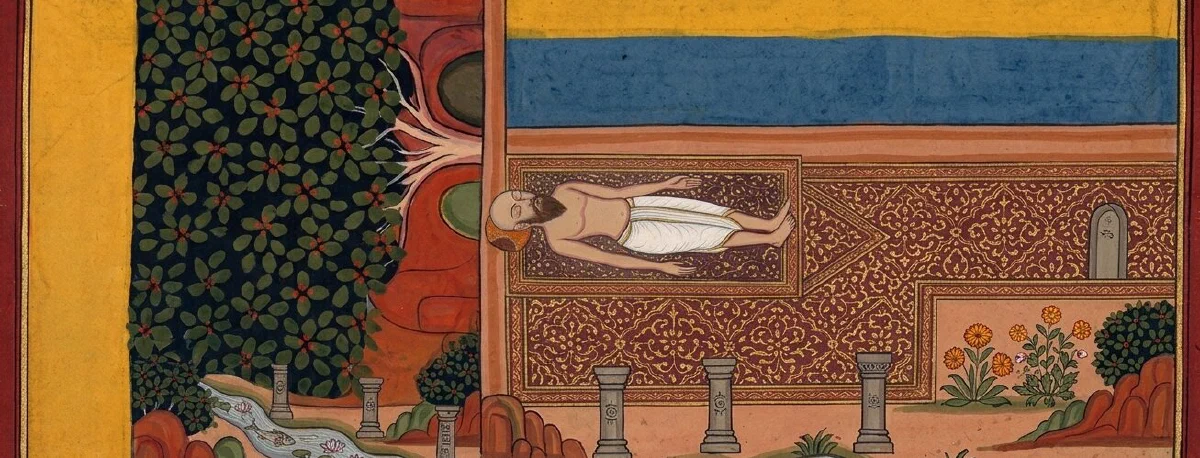

The Corpse Pose is one of the most fundamental exercises in Hatha Yoga. Although its outward form appears at first glance like a simple, deep sleep, the practice in truth demands an exceptionally high degree of conscious presence and inner alertness. In Sanskrit, the posture is referred to as Savasana (शवासन), precisely derived from the words śava for corpse or carcass and āsana, which translates to seat, posture, or abiding. It forms the ritual and energetic foundation for fully integrating the preceding dynamic movement practice.
Far beyond mere physical recovery, this position marks the transition from outer action to inner contemplation. While the muscles systematically release every remaining tension to the floor, the mind remains awake and detached. A state of pure observation arises, in which there is no reaction to thoughts or external stimuli. In this conscious immobility, the awakened life energies harmonize, the breath settles into its natural rhythm, and the nervous system receives the signal for profound regeneration. Savasana is therefore not a passive waiting, but the ultimate practice of letting go and the conclusion of every holistic yoga session.
Origin and History
The oldest written mention of the Corpse Pose is found in the 15th century in the Hatha Yoga Pradipika, one of the most influential foundational works of the yogic tradition, written by Yogi Swatmarama. In the first chapter (verse 32), the posture is precisely described in its purist essence for the first time and is translated as follows:
Lying flat on the floor with the back, like a stretched-out corpse, is called Shavasana. It removes fatigue and promotes calmness of the mind.
Historically speaking, this posture in medieval Hatha Yoga by no means served only for mundane physical recovery after strenuous exercises. Rather, it was considered an essential, preparatory state for the deepest meditation (Laya) as well as for the complete dissolution of dualistic thinking, in which the separation between the practitioner and the environment blurs.
The profound symbolism of the “little death” is of central importance here. It stands for the conscious, step-by-step shedding of worldly identifications, fixed ego structures, and all manifested physical tensions at the end of an intensive exercise practice. One dies symbolically to the past and the effort, only to be reborn completely unburdened in the present moment. One or zero, in Shavasana there is only relaxation or restlessness, every second a choice is made until it is forgotten and relaxation takes over everything.
In the 20th century, yoga radically reinvented itself and adapted to the needs of the modern, often overstimulated human being. Pioneering masters recognized the invaluable therapeutic value of this posture and firmly anchored the position as an indispensable, systemic closing sequence in modern yoga. Only through this structured integration did Savasana become the cherished haven of peace that forms the harmonious conclusion in almost every yoga class worldwide today.
Classical Execution
The execution takes place in the supine position on a flat, firm surface.
-
Assuming the position: The body is placed centrally on the back. The legs lie mat-width apart, so that the tips of the toes can fall loosely outward all by themselves.
-
Arms and hands: The arms rest flat on the floor with some space from the torso (approx. 30 to 45 degrees). The palms face upward to passively open the shoulders.
-
Head and neck: The back of the head rests centrally, the neck is long, the chin tends minimally toward the sternum.
-
The inner attitude: The eyes are gently closed. The breath flows completely free and uncontrolled through the nose. Any willful influence on the body is ceased.
Method of Autosuggestion
To release the deep muscle block, the mental body journey (autosuggestion) is used in the tradition of classical Hatha Yoga and Yoga Nidra. In this process, awareness is systematically guided through the individual body parts, combined with the mental command of letting go.
The classical sequence runs from the peripheries to the center:
-
“I relax my toes… my toes are completely relaxed.”
-
“I relax my feet and my ankles… feet and ankles let go completely.”
-
“I relax my calves, shins, and knees… the joints become soft.”
-
“I relax my thighs and my buttocks… the pelvis sinks heavily into the floor.”
-
“I relax the lower back, the abdomen, and the chest… the internal organs become quiet.”
-
“I relax my fingers, my hands, and wrists… the arms rest heavily.”
-
“I relax my shoulders and my neck… all burdens fall away.”
-
“I relax my scalp, my forehead, and my eyes… the eyelids become heavy.”
-
“I relax my jaw, the tongue detaches from the palate… the whole face is soft.”
This form of focused attention interrupts the transmission of chronic muscle tension stimuli and leads the nervous system into a state of conscious trance.
Variations Without Props
If the classic supine position causes pain due to physical limitations or tension, anatomical variations are used that manage without external props (such as pillows or blocks):
Constructive Rest Pose: The feet are placed mat-width apart and the knees sink toward each other in the middle so that they support one another. This immediately relieves the lumbar spine region and the hip flexor (psoas).
Prone Position (Advasana / Matsyasana variant): Lying on the stomach, with the hands placed under the head as a pillow and the big toes touching, while the heels fall outward. Suitable for acute discomfort in the supine position.
Side-Lying Position (Fetal Position): Rolling onto the right side of the body, the right arm under the head as a pillow, the knees slightly bent. This posture relieves the vena cava and is traditionally also used for a gentle transition after waking up from Savasana.
Effects and Clinical Studies
The primary effect of Savasana is based on the targeted activation of the parasympathetic nervous system (the so-called “rest and digest” mode). During physical immobility, muscle tone, heart rate, and blood pressure drop.
Core medical effects:
-
Reduction of stress hormones: The concentration of cortisol and adrenaline in the blood drops measurably.
-
Brainwave shift: The brain switches from the fast beta waves of everyday waking states to the slower alpha waves (8–12 Hz) and partially theta waves, which are characteristic of deep relaxation, creativity, and mental regeneration.
-
Cardiological relief: Due to the horizontal position, the heart does not have to work against gravity, which lowers the peripheral resistance of the vessels.
Clinical Evidence:
-
Clinical studies (including by Bera T.K. et al.) showed that recovery after acute physical exertion (e.g., treadmill tests) in Savasana is significantly faster than when sitting on a chair or in a normal resting supine position. Pulse and blood pressure returned to baseline levels in less time.
-
Further studies in the field of psychosomatic medicine prove that the regular practice of Savasana can be effectively used as a complementary therapy for essential hypertension (high blood pressure) and chronic sleep disorders (insomnia), as it balances autonomic dysfunction of the nervous system.
Everyday Benefits
The long-term benefit of this practice lies in training interoceptive awareness – the ability to precisely register internal body signals. Anyone who learns to consciously detect and release the smallest muscle tensions in the jaw or shoulders while lying down develops a finer sensitivity to stress signals in everyday life. Savasana acts like a neurological reset that strengthens psychological resilience and reduces mental exhaustion.
Perspective
Savasana is not a state of unconsciousness and not an ordinary sleep. The art of the posture lies in the perfect balance between physical lethargy and mental clarity. While the body is largely sensorially deprived and resembles a corpse, consciousness remains active as a pure observer.
In this state, the practitioner experiences themselves detached from pressure to perform, movement, and thought streams. This perception forms the actual conclusion of a Hatha Yoga session: the realization that rest is not a passive absence of movement, but an independent, powerful state of integrity.